Time for Disruption - A CQI & Qualiexpert article
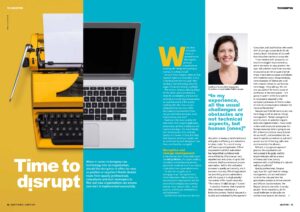
This newsletter is special for an extraordinary reason: this semester we have reached the CQI - Chartered Quality Institute , I'm pleased to be able to share this incredible achievement with you.
I, Patricia Vasques, gave an interview to Quality World magazine, exclusive to CQI, about the role of the Quality professional in times of disruption and the implementation of new technologies. With the publication, I was assured that I am aligned with the best knowledge on Quality Management and processes and that I can provide clients and friends in the community with a human and technical understanding of this discipline.
For those who don't know, CQI is a renowned British institution that has been working on quality-related activities since 1919. “For over 100 years, we have championed organizational excellence by setting professional standards for quality management in the UK and globally. With 18,000 members in 100 countries, we are a partner for quality management professionals and, through our International Register of Certified Auditors (IRCA) certification, for systems audit professionals.”
Quality World magazine is exclusive to subscribers, but I have obtained permission to publish the article, which deals with subjects such as change management, knowledge management, continuous improvement, leadership and project management during the implementation of new technologies, in 5 chapters:
- Disruption and change management
- Transformation tools
- Testing as part of the design process
- A role for standards
- A positive outlook
“How can you protect what you have, while also making improvements?
How can you streamline processes while implementing new ones?”
If you're going through this, I recommend reading it, as new reflections can emerge and can support you in your activities as a Quality professional. If you're not going through this, I recommend reading it to ensure systemic thinking in your activities 🙂
Below is my free translation from English into Portuguese.
Happy reading!
Link to the original article in English
When it comes to bringing new technology into an organization, should disruption be seen as positive or negative? Martin Bewick listens to quality professionals, consultants and technology developers to find out how organizations can ensure that new technology will be implemented successfully.
What does disruption mean in general terms? Interruption, perhaps? A separation or rupture? Things not working as normal, or as they should?
For technology companies, however, there are few negative aspects of disruption. In fact, it has been the Holy Grail. Why develop a new technology, they argue, if it doesn't change anything?
This tension, between changing things for the better and the simultaneous desire for predictability and business continuity, in a way encapsulates an essential aspect of the quality professional's role. How can you protect what you have while also making improvements? How can you streamline processes while implementing new ones?
Nowhere is this more acutely felt than in the drive towards digitalization, automation, artificial intelligence and machine learning - the friendly trend of technological development that underpins Quality 4.0. Sooner or later, everyone working in Quality is likely to be confronted with technological disruption. So how can this best be managed?
Disruption and change management
In the Deloitte Tech Trends 2022 report (see bit.ly/3lkfcbe), the global auditing, consulting and professional services giant takes a closer look at how IT as a whole is disrupting the way organizations work.
“In what we recognize as an emerging trend,” says the report, “Chief Information Officers (CIOs) are disrupting their organizations and the armies of technologists who currently perform many manual tasks... in systems, architecture, development and deployment.”.
Deloitte finds that the trend towards disruption in technology is having a beneficial impact, with efficiency gains and reductions in labor costs: “In a recent survey of IT and engineering leaders, 74% of respondents said automation helped their workforce work more efficiently. Fifty-nine percent saw reported cost savings of up to 30% in teams that adopted the automated process. Add to this noticeable increase in quality and safety and it becomes clear why 95% of respondents are prioritizing process automation, with 21% saying it is a high priority.” The section of the report concludes: “The time to (finally) realize IT disruption is now.”
In practice, however, this imperative does not always translate into a frictionless process. Patrícia Vasques is a Quality and Sustainability Management Consultant and Lead Auditor working with oil and gas companies in Rio de Janeiro, Brazil. She knows all too well how bumpy a journey disruption can be.
“I've worked with companies implementing new technologies, and it's never been an easy process,” she says. “All the activities need to be very well structured so as not to cause internal chaos. I've seen successes and failures with implementation. Sadly, some examples of failures are related to a team's refusal to use the new technology - they'll say, ‘the old one was better!” or there's a lack of confidence in the new system - ‘will it work? Or the new system is not properly adapted to the company's processes. Or there's a lack of internal communication between the team and the leadership.’
Vasques says that introducing any new technology should be seen as change management. “Senior leadership needs to check all the potential impacts before implementation. There is a need to have a well-structured action plan for: human resources (who will use it?), infrastructure (how many licenses do we need?), and procedures (do we need to update procedures or policies?); as well as a lot of training, with communication to all users.
Without a change management process, the organization will not succeed in its objectives, and the implementation will be a waste of money and time, leaving everyone with a bad feeling about a task not done well.”
Quality professionals, Vasques says, have the right tools for change management, and are in a good position to check the risks and carry out the preventive actions to deliver an efficient transformation. The biggest obstacle, she adds, is usually people. “In my experience, all the usual challenges or obstacles are not technical aspects, but human aspects. It often has to do with people who aren't engaged, or leadership that doesn't offer support or motivation to the team. During the implementation of a new technology, motivation, transparency and patience are vital to strengthen commitment and participation and reduce resistance.”.
Above all, it says Vasques, any feelings of negativity need to be overcome. “Quality professionals should check with the team why the new technology is being seen as a negative disruption. Perhaps, in the past, a new technology was implemented with errors. In this case, what lessons have been learned and does the team now have the right tools for knowledge management? It's extremely important not to make the same mistakes again.”
As a summary of the role of the quality professional in this process, Vasques quotes Alfred North Whitehead, a mathematician who studied the philosophy of processes: “The art of progress,” he said, “is to preserve order in the midst of change and to preserve change in the midst of order.” Once again, he describes a tension, or a balancing act, that will be familiar to Quality practitioners.
Transformation Tools
Organizational transformation through the implementation of a new technology can - could and should - be argued to be a rigorous and intensive process. This, however, does not always prove to be the case.
Adeyemi Shodipo, who is based in the North West of England, is a Systems Management Consultant and conducts CQI and IRCA approved training at Charis - Training Company. He works with products and service providers in the food supply chain to maintain competitive advantage.
“From my auditing experience,” he says, “I've seen new technologies brought into organizations where the company has completely transformed itself and automated its processes from one year to the next.”.
In such cases, the role of quality becomes even more important if the right checks and preventive actions are applied quickly. “The implementation of technology should not happen as an independent or isolated process, away from the existing quality infrastructure,” says Shodipo. “The quality professional needs to keep a rational head while others may get excited about the new technology, and make sure that the levels of excellence expected by the customer remain firm during any disruptive change. To do this, you need cross-functional communication to make sure there are no blind spots during execution.”.
All new technologies bring with them a degree of uncertainty, adds Shodipo. The teams that will be using them, for example, may not yet have all the technical knowledge to fully understand the new technology's capabilities. The quality function's skill set around risk management and the ability to absorb new information quickly will be vital during the implementation period.
“Adopting new technologies requires monitoring the progress of the project,” he says. “To help, I think ISO 9001 requirement 8.3: Design and development of new products and services, is a simple but very powerful tool when implementing new technology or systems within an organization. Another useful tool is Failure Mode and Effect Analysis (FMEA), which can help identify potential risks in the design phase.”
“Quality professionals must work closely with the project team, and there needs to be rigorous validation to test the effectiveness of the new technology in the context in which it will be used. If the technology is going to be used in several contexts, then the validation needs to be very robust in its testing.”
Testing as part of the design process
Rigorous testing of new technologies is central to Kay Westrap's work. She is Test Manager at H30 Digital, a digital transformation consultancy specializing in Microsoft applications and services. “Whether it's disruptive or not, all digital technology is best written with the end product in mind,” she says. “If you work backwards from the perspective of what success looks like, you have a test plan built in.” It's a point that quality practitioners should keep in mind during any transformation process.
“When you have a clear definition of the set of requirements, you can see what the testing methods need to be,” she says. “A strategy should be put together with the tests that will be conducted, how this fits in with the development of the technology, and what methodologies and tools you are using. This defines the intention of the activity. A work plan can be constructed, taking into account the knowledge you have built up for the strategy, as well as the requirements for the application being tested - known as the Application Under Test (AUT).
“Testing can be seen as a series of processes that, when conducted in a considered manner, will give you a good understanding of the robustness of the AUT and any developments or corrections that may need to take place before launch.”
That's the theory, at least. In practice, Westrap says that many organizations see the test as “nice to have” or an afterthought. “It becomes an expense that is squeezed in and attached like an insurance policy,” she says. “Radical testing should sit alongside agile technology in development and it should all be focused on the endgame. The whole process, all the people and roles involved in it, should be thought through when building the project plan and test strategy.
“The structure of the test plan may vary depending on whether you are using an ‘agile’ or “waterfall” methodology, but they will still have the same people involved. For example, there should be an overarching project manager, or possibly a product manager, who ensures that all team members are informed and that progress is tracked.”
Westrap adds that someone should be responsible for keeping a list of risks and other potential problems, and monitoring the project's progress on a daily basis. They should report any potential delays to the relevant stakeholders and consider any preventative actions that may be required to mitigate risks. Stakeholders should be involved from the start of the project, to ensure that the end result is not a surprise and, if any decisions need to be made, that they are already fully engaged.
“The best technology implementation projects have large, collaborative teams seeking to achieve a common goal,” says Westrap. “Everyone is aligned and not looking to pass the blame, and they look for viable solutions to problems. Stakeholders should be present at team meetings and other communication touchpoints and there should be transparency as and when any problems arise. If any change of direction is needed, buy-in from the whole team is required first.
“They have established common working practices and agreed ways of working. They are expecting success, but planning for failure. They are self-critical and willing to accept change and have a ‘kaizen’ mentality - one of continuous improvement. At the end of the project, they look back and try to understand what lessons can be learned, present best practices, but also seek to constantly improve.”
Where technology projects fail, she says, is when there is often an insistence on continuing to do the same thing, even when the project starts to veer off course. “It also happens: when stress is heaped on individuals and blame is sought, creating a culture of fear and secrecy; where lessons learned are ignored; where leaders don't have an open mind about changing or being challenged; and where the well-being of the team is not considered alongside the needs of the project or the client.”.
There is, then, plenty of room for friction and failure, but Westrap says that developing and testing technologies is not rocket science; it is simply a process that will run more smoothly if it is managed well. Perhaps then it would be useful to rephrase ‘disruption’ - with its connotations of interruption - and instead think of it simply as “transformation”. .
A role for standards
Adrian Overall is CEO of CloudStratex, a business transformation consultancy that advises well-established companies on how to harness technology effectively. His clients include the London Stock Exchange, Aviva, Credit Suisse and Deutsche Bank. He sees new technologies, such as automation and enterprise service management platforms, as a transformative opportunity for quality management.
“A large part of quality management is based on making improvements, whether to an organization's culture, services or processes,” Overall says. “These platforms and tools that can be implemented today can place a heavy emphasis on improving business processes through improved workflows and the intelligent use of data. For example, by implementing a “Configuration Management Database” (CMDB), quality management professionals can improve business processes by increasing opportunities for automation. After all, their ongoing projects to enhance business processes - or operational efficiency - can only be realized if organizations are fully aware of what they have to work with.”.
While Overall is in this business championing these technology platforms, he also recognizes the risk of bringing in technologies without understanding the specifics of how it can help. Here, industry standards can help ensure success. “Although tools like CMDB have a lot of potential, we don't advocate leaning too heavily on technology,” he says. “It's still crucial to combine this type of tool with the right processes and expertise to make the most of the efficiencies they offer.
“The CMDB and its related processes are integral parts of ISO 20000 [IT service quality management]. However, the mandate to support reliable and accurate data means that a CMDB is useful for many ISO standards, from 27.001 to 9.000.
“It's also hard to ignore the increasingly stringent regulation of operational resilience demands from bodies such as the FCA [Financial Conduct Authority] - or the huge fines that await organizations that fail to comply. So the knowledge that a CMDB can provide is essential not merely to ensure resilience, but also to understand whether your organization is resilient.”.
A positive outlook
For Overall, technology can help quality professionals take stock of how the different components of their business are connected - be it people, facilities, business applications or infrastructure. Yet for many organizations, upgrading to the latest technology still seems daunting and expensive. But what if an organization doesn't make the change?
“There is a tangible and calculable impact when organizations feel intimidated by technological transformations, especially when they go to the cloud,” says Overall. “For years, migrating from an on-premises data center to the cloud has been lauded as the most efficient, convenient and cost-effective option for organizations. Many, however, have since been disappointed by the unexpected and substantial expense of cloud technology.
“In reality, the consequences of too many attempts to adopt the cloud have left some businesses with one foot in the cloud and the other firmly planted in their surviving legacy infrastructure. We've found organizations paying eight-figure annual bills for cloud services, while facing £100 million costs for legacy infrastructure.
“This is one aspect of adopting new technologies: their daunting and expensive nature can leave organizations reluctant to commit wholeheartedly, leading to substantial inefficiencies. That's not to say that these changes shouldn't be made - just that they should be done properly, with care and planning. Refusing to make concessions to the latest technology has its own set of disadvantages, not least in the form of missed opportunities to achieve new operational efficiencies, and in embracing those all-important requirements of resilience.”.
From the quality manager to the auditor, and from the consultant to those responsible for developing and testing new technologies, there seems to be a consensus that disruption must be a means of delivering the transformation the organization needs to increase business continuity and competitive advantage, and to meet safe standards and resilience in the coming years, in line with regulatory requirements.
The implementation of new technologies, however, needs to be managed by professionals who can take a holistic view of the process. They must be adept at change management, able to communicate openly with all stakeholders and keep an eye on the end goal. It's also about embracing the opportunity.
For a final word, Shodipo says: “As a quality professional, it's vital that you stay relevant by taking an interest in what's new. As such, we should see disruptive technologies as a positive. They can bring a real competitive advantage and are an opportunity to improve ourselves for the future.”.
If your new technology isn't going to help prepare your business for the future, the disruption it causes is never likely to be transformative and positive.
Qualiexpert Services - Processes that add value
Navigating the waters of change management can be an overwhelming challenge, but you don't have to face it alone. We're here to support your organization at every stage of this transformation, helping you adapt and thrive in an ever-evolving business environment.
From impact analysis to effective implementation and resistance management, our team of change experts is ready to guide and facilitate this process. Contact us to learn more about how we can help your company manage change strategically, ensuring a smooth and successful transition to the future.
Qualiexpert Community
If you like our newsletter and want to be kept up to date with the latest news, insights and exclusive resources on quality and sustainability management, join our community now and receive all our updates directly in your e-mail.